The Central African Republic holds one of the finest rainforest wildlife experiences in Africa inside one of its most unstable countries.
Read more about Central African Republic →Capital: Bangui
Currency: XAF
Best time: December to March: the main dry season, and the best window for Dzanga-Sangha.
See more →Comfort: MID RANGE
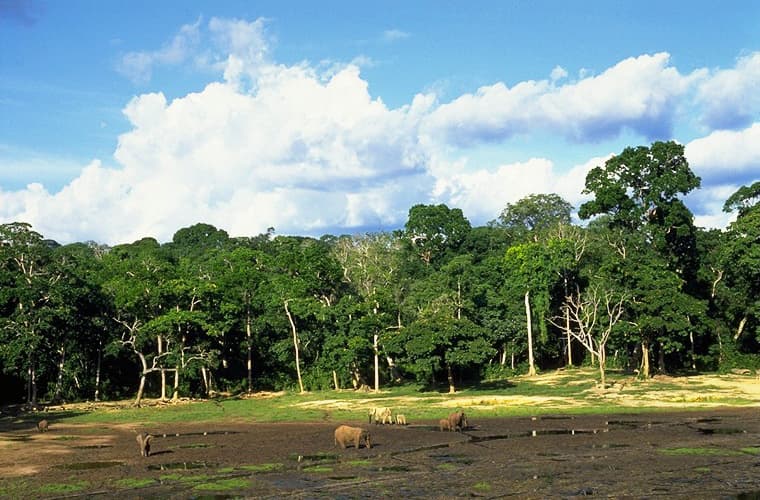
The Central African Republic holds one of the finest rainforest wildlife experiences in Africa inside one of its most unstable countries. Dzanga-Sangha, in the far southwest where CAR meets Cameroon and the Republic of Congo, is the exception to almost everything else here. Dzanga Bai is a forest clearing where up to a hundred forest elephants gather at once on the mineral-rich mud, watched from a raised platform, there is nowhere comparable. The reserve also… offers habituated western lowland gorilla tracking, and time with BaAka trackers whose knowledge of the forest is the reason the habituation worked at all. It is a UNESCO World Heritage Site. Access is via Bangui and then a long drive, or by charter to Bayanga. A handful of specialist operators run trips, generally routed through Cameroon or Congo to avoid the interior. The rest of the country has been affected by armed conflict since 2012. Most governments advise against all travel, and the security situation outside the southwest corner is volatile.
The tour operator with published trips in Central African Republic.
December to March: the main dry season, and the best window for Dzanga-Sangha. The dry season, roughly December to March, is when forest tracks in the southwest are passable and the bai viewing is at its most reliable. This is the period the specialist operators run. A shorter drier interval around June to August is also workable, and gorilla tracking can be better then, as the animals range shorter distances when fruit is plentiful. The heavy rains fall roughly April to November, peaking around August to October. Roads into Bayanga become extremely difficult, river levels rise and the last stretch of access can be cut off entirely. Even in the dry season this is rainforest and rain should be expected in any month. Zakouma-style savanna game viewing does not really exist here; the draw is forest, and forest wildlife is less season-dependent than savanna game but far more dependent on whether you can physically reach it. Security, not weather, determines whether a trip runs. Confirm the current position with your operator and your government before committing.
A visa is required for all nationalities and must be obtained before travel; there is no visa on arrival. Apply at a CAR embassy or consulate with a completed application, passport photos, a passport valid at least six months beyond arrival with blank pages, a letter of invitation or confirmed booking from a registered operator, proof of accommodation, a return ticket, evidence of funds, and your yellow fever vaccination certificate, which is mandatory and checked at the border. Visas are issued for 30 days, 60 days, 90 days or one year. Processing can be slow and approval is discretionary. On arrival, registration with the immigration authorities may be required, and travel outside Bangui generally requires additional permits and clearance. Checkpoints are frequent and carrying your passport at all times is essential. Photography is restricted; do not photograph officials, military or government buildings. Most travellers to Dzanga-Sangha route in through Cameroon or the Republic of Congo rather than crossing CAR overland, which involves different border formalities, your operator will advise. Most governments advise against all travel. Standard travel insurance is void under such an advisory; specialist cover is required.
Yellow fever: vaccination is mandatory and proof is required both for the visa and on arrival. Get it at least ten days before travel. Malaria: risk is high and year-round throughout the country. Prophylaxis is essential for every visitor, without exception. Commonly recommended: hepatitis A and B, typhoid, polio, cholera, meningococcal, tetanus-diphtheria, measles, chikungunya and rabies. This is a country where the full list genuinely applies rather than being precautionary boilerplate. Gorilla tracking rules are strict: no one with a respiratory infection may trek, masks are mandatory and minimum distances are enforced. The Congo Basin has periodic Ebola and mpox outbreaks; check the current position before travelling and cooperate with screening at borders. Drink only bottled or properly treated water. Do not swim in fresh water: schistosomiasis is widespread. Sleeping sickness is present in parts of the forest zone. Medical facilities are among the most limited in the world, largely dependent on NGO and mission clinics, and there is effectively no emergency care outside Bangui. Bring a complete supply of prescription medication and a comprehensive first-aid kit. Specialist high-risk insurance including guaranteed air evacuation is essential. Confirm the provider will actually fly into CAR. Consult a travel medicine specialist at least eight weeks ahead.
Central African Republic on the map
Hand-picked safaris, beach escapes, and cultural journeys across Central African Republic.