Angola opened to tourism late, the civil war ended in 2002 and visa liberalisation only came in 2018, and it remains one of the continent's genuine frontiers.
Read more about Angola →Capital: Luanda
Currency: AOA
Best time: May to October: the cool dry season, with clear skies and passable roads.
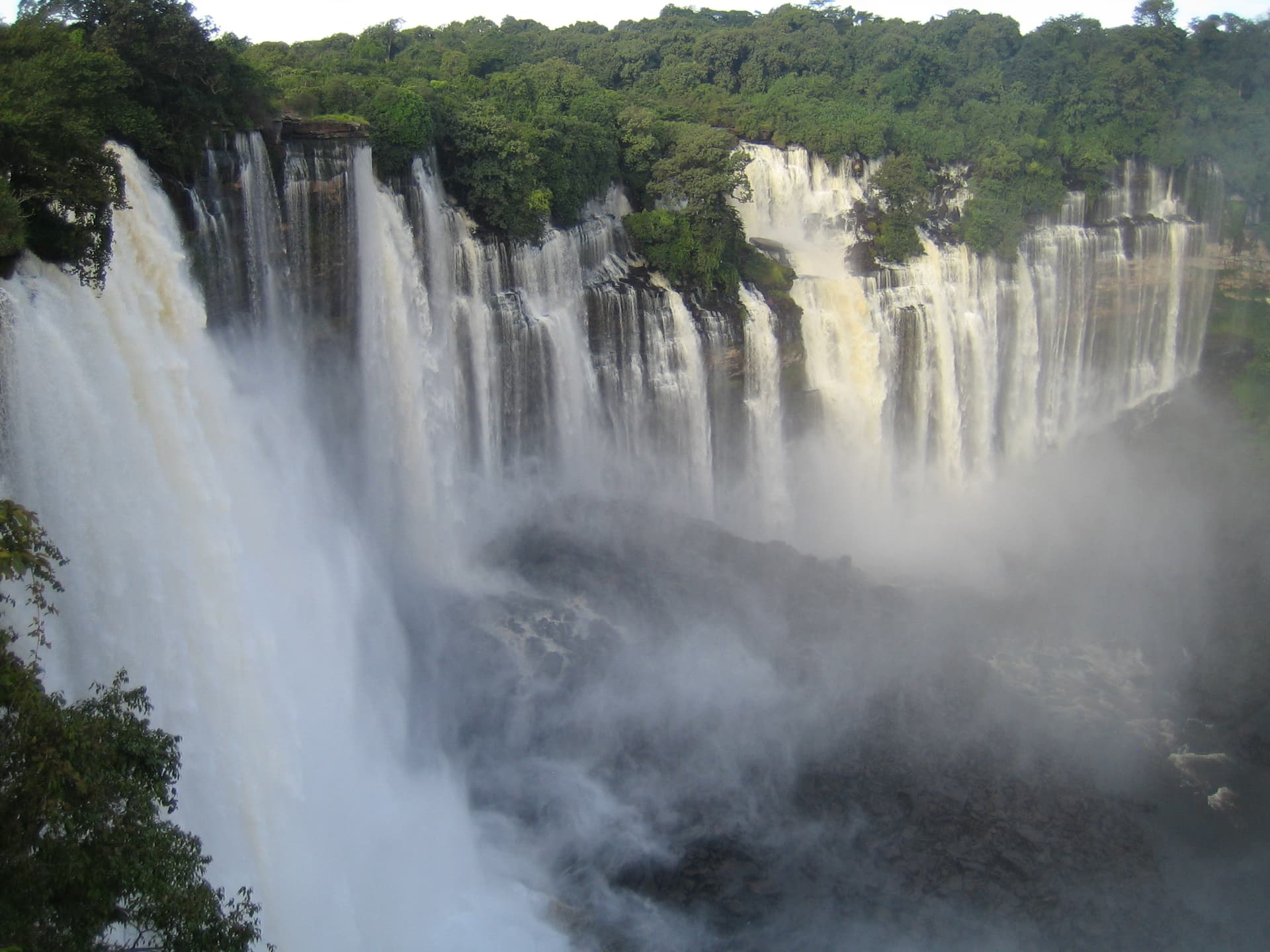
See more →Angola opened to tourism late, the civil war ended in 2002 and visa liberalisation only came in 2018, and it remains one of the continent's genuine frontiers. Kalandula Falls in Malanje province is the headline: 105 m high and around 400 m wide, one of the largest waterfalls in Africa by volume, and usually visited alongside the Pedras Negras de Pungo Andongo, a formation of enormous black monoliths rising out of flat grassland. The Miradouro… da Lua south of Luanda is an eroded moonscape of clay cliffs above the Atlantic. The south is the strongest region for travellers. Namibe province holds the Iona National Park, welwitschia plants that live for over a thousand years, and the desert running down to the Namibian border. The Tundavala Gap near Lubango is an escarpment viewpoint with a 1,000 m drop. Luanda is one of the most expensive cities in the world, a legacy of the oil boom. Infrastructure outside the capital is thin and most visitors travel with an operator or a well-equipped 4x4.
May to October: the cool dry season, with clear skies and passable roads. The dry season, May to October, is the practical window. Temperatures sit around 23–28°C, humidity is low, skies are clear and the unsealed roads that reach most of the sights are in their best condition. This is when overland travel through Malanje, Namibe and the south is realistic. The trade-off is the waterfalls. Kalandula is at its most powerful at the end of the rains, roughly March to May, when the volume is spectacular, but the approach roads are at their worst. Late April and May is the usual compromise. The rainy season runs November to April, hotter and more humid with heavy afternoon thunderstorms. Dirt roads in the interior become difficult or impassable, river crossings flood, and travel times double. The coastal strip is drier than the interior year-round thanks to the cold Benguela current, and Namibe in the far south is genuine desert.
Angola liberalised entry significantly and it is now far more accessible than its reputation suggests. Nationals of a substantial list of countries, including the United States, United Kingdom, Canada, Australia, most EU member states and much of southern Africa, may enter visa-free as tourists for up to 30 days per trip, with a maximum of 90 days in a calendar year. Check whether your nationality is on the current list, as it has been revised more than once. Where a visa is needed, Angola operates an eVisa through the migration service (SME). Requirements include a passport valid at least six months beyond departure with two blank pages, a recent digital photo, proof of accommodation and a return flight, evidence of funds, and a yellow fever vaccination certificate. Processing typically takes five to ten working days. Yellow fever proof is required at the border whether or not you need a visa. Carry the certificate. Angola has a reputation for bureaucratic checkpoints; carry your passport and, if driving, full vehicle documentation at all times. Confirm current requirements before booking.
Yellow fever: vaccination is mandatory for all travellers to Angola and the certificate is checked on arrival. It must be at least ten days old to be valid. Angola has had significant yellow fever outbreaks, so this is enforced rather than nominal. Malaria: risk is high and year-round throughout the country including Luanda. Prophylaxis is strongly recommended for every visitor. This is one of the higher-transmission settings in southern Africa. Commonly recommended: hepatitis A and B, typhoid, cholera, tetanus-diphtheria-polio, meningococcal, and rabies for rural travel. Cholera outbreaks occur, particularly in Luanda's informal settlements and after flooding. Drink only bottled or properly treated water and be strict about food hygiene. A less obvious hazard: landmines. Angola remains among the most heavily mined countries in the world despite decades of clearance, and contamination persists in parts of the interior and along old front lines. Do not leave marked roads and tracks in rural areas, do not camp on untested ground, and take local guidance seriously. Medical facilities are limited and expensive even in Luanda. Insurance covering air evacuation to South Africa is essential. See a travel clinic six weeks ahead.
Angola on the map
Hand-picked safaris, beach escapes, and cultural journeys across Angola.