South Africa vs. Namibia: The Ultimate Road Trip Showdown
Africa Travel Bookings
· 5 min read
Published: 30 August 2026 | Category: Adventure & Exploration | Tags: South Africa, Namibia, Self-Drive, Garden Route, Sossusvlei
There are few better ways to experience Southern Africa than from behind the wheel. A road trip through this region is not simply about getting from one attraction to another; it is about the changing landscape outside the window, vineyards giving way to mountains, mountains opening onto grasslands, forests appearing beside dramatic coastlines, and wildlife suddenly crossing the road.
Two countries stand out for African self-drive adventures: South Africa and Namibia. Both are excellent road-trip destinations, but they deliver remarkably different experiences. South Africa offers extraordinary variety, letting you combine Cape Town, the Cape Winelands, the Garden Route, wildlife reserves, mountains, beaches, cosmopolitan cities, and some of Africa's most famous national parks in one trip. Namibia is almost the opposite: it is defined by space, isolation, and dramatic arid landscapes, where the road itself becomes part of the attraction, running through enormous desert landscapes, across gravel plains, and toward towering red dunes, ancient canyons, and wildlife congregating around remote waterholes.
South Africa wins on variety and infrastructure. Namibia wins on wilderness, scenery, and the pure self-drive adventure. The right choice depends on what you want from the journey.
South Africa: The Road Trip With Everything
South Africa's greatest advantage is its extraordinary geographical diversity. A traveller can begin in Cape Town, drive through the Cape Winelands, continue along the Garden Route, explore forests and beaches, head inland toward mountain country, and finish with a Big Five safari. Few destinations offer such a combination within a single national road network.
The Garden Route is particularly famous. Running along the southern coast between the Western and Eastern Cape, the N2 corridor between Heidelberg and Storms River combines beaches, indigenous forests, mountains, lagoons, wildlife areas, and small coastal towns, including Mossel Bay, Wilderness, Knysna, Plettenberg Bay, and Storms River, each offering the chance to break up the drive with accommodation, restaurants, hikes, and outdoor activities. The route is remarkably flexible too: travellers can spend a few days driving slowly between coastal towns, or use it as part of a much longer journey incorporating Cape Town and the Eastern Cape. Adventure travellers can add forest walks, kayaking, hiking, whale watching, and bungee jumping, while families gain beaches, wildlife encounters, and relatively accessible driving.
Then there is the safari. South Africa has one of Africa's strongest road-trip combinations, since travellers can incorporate a safari without completely changing the character of their holiday. Kruger National Park has nine entrance gates, several accessible from the major road network, so a road trip can combine conventional sightseeing with self-drive game viewing: you could spend the first part of your trip exploring Cape Town and the Garden Route before flying or driving toward the Lowveld and continuing into Kruger, or use Johannesburg as the starting point for a northeastern road trip toward the park. The Drakensberg Mountains add another dimension, with spectacular scenery, hiking opportunities, and thousands of ancient rock-art paintings.
South Africa, then, works exceptionally well for travellers who dislike repetitive itineraries. One day may involve wine tasting, the next a mountain hike, the following morning a game drive, and that variety is difficult to beat.
Namibia: Where the Road Becomes the Destination
Namibia offers a fundamentally different experience. The attraction is not simply what lies at the end of the road; the journey itself is the experience, and Namibia's enormous landscapes create a sense of scale that can be difficult to appreciate until you are actually driving through them.
The country is one of the world's most appealing destinations for self-drive tourism. Namibia's tourism authority explicitly recommends exploring the country by car and notes that at least 80 percent of its roads are gravel; those roads are generally well maintained, but driving times must be planned carefully, since gravel roads require slower speeds, and a sturdy 4x4 is worth considering for additional safety, clearance, and capability. A Namibian road trip, then, is not simply a conventional holiday with a rental car; it requires drivers to understand distances, fuel planning, road surfaces, and weather.
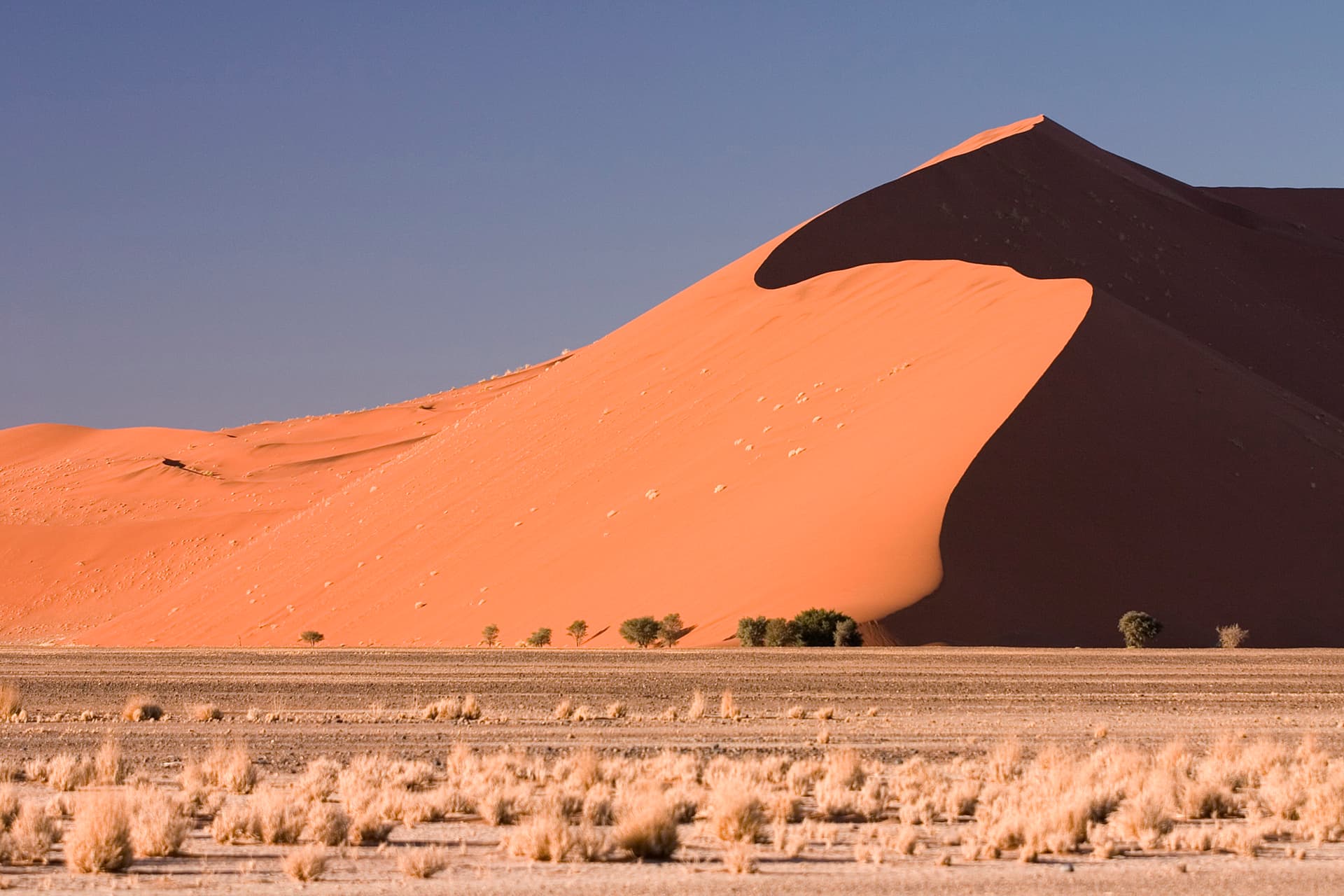
The reward is immense. One of Namibia's defining experiences is Sossusvlei, where enormous red-orange dunes rise from the Namib Desert around the famous white clay pan, and the contrast between dunes, blue sky, and stark desert environment makes this one of Africa's most recognisable landscapes. Further south lies the Fish River Canyon, another enormous geological spectacle, and Swakopmund, where the desert meets the Atlantic Ocean, opening onto the Skeleton Coast and a completely different landscape again. Namibia is not only about scenery, though: Etosha National Park is one of the most distinctive safari destinations in Africa, with a huge salt pan and waterholes creating a landscape where animals can sometimes be observed around scarce water sources. May to October is generally the best period for wildlife viewing here, since animals become easier to observe during the dry season as they congregate around waterholes, which makes Namibia especially attractive to photographers: the scenery provides enormous visual scale, while wildlife can often be photographed against relatively open backgrounds.
The Driving Experience: South Africa versus Namibia
This may be the most important distinction between the two.
South Africa generally offers a more conventional driving experience. Major tourist routes are paved, fuel stations are relatively accessible, and there is a broad network of accommodation and services, though travellers should not assume driving is risk-free: fatal road accidents are common, particularly around weekends and public holidays, so drive cautiously, observe speed limits, and keep fuel levels above half a tank. Driving also requires greater awareness in urban environments, where traffic, pedestrians, and local driving behaviour can vary considerably.
Namibia generally has less traffic and substantially more isolation, which can make driving feel more peaceful, but it also increases the importance of preparation. Gravel roads are widespread, so check road conditions, carry sufficient water, and avoid night driving outside towns, since wildlife and livestock can pose serious hazards, and during the January to April rainy season, some gravel roads can deteriorate significantly. In Namibia, a puncture or breakdown can be much more consequential too, since another vehicle may be many kilometres away, which is why experienced travellers often treat Namibia as a genuine overland adventure rather than simply a rental-car holiday.
Which Has Better Scenery?
This is subjective, but the difference is clear. South Africa offers more types of scenery, mountains, forests, vineyards, beaches, rolling farmland, cliffs, grasslands, and savannah, while Namibia offers more dramatic emptiness: deserts, enormous dunes, rugged mountains, gravel plains, salt pans, canyons, and an almost extraterrestrial coastline. The Namibian landscape is particularly powerful for travellers who appreciate photography, geology, and vast open spaces, since you can drive for long periods with barely another vehicle in sight, and that solitude is one of the country's greatest attractions.
Which Is Better for Wildlife?
This is a more nuanced comparison. South Africa generally has the stronger overall safari infrastructure, particularly around famous reserves such as Kruger, making it easier to combine self-drive wildlife viewing with extensive accommodation choices, guided game drives, and other tourism services. Namibia, though, offers a very distinctive wildlife experience: Etosha's waterhole-based viewing can be exceptionally rewarding during the dry months, and Namibia is also famous for wildlife adapted to arid environments, particularly in its desert regions. Choose South Africa for a classic, flexible Big Five safari experience, and Namibia for wildlife combined with extraordinary desert landscapes.
Which Is Better for First-Time Road Trippers?
For someone who has never driven a long-distance route in Africa before, South Africa is generally the easier starting point. Its tourism infrastructure is extensive, travellers have more choices of accommodation, restaurants, fuel stations, and alternate routes, and the road-trip possibilities are easier to scale, from a five-day Garden Route trip to a multi-week journey. Namibia requires more disciplined planning, since distances can be enormous and gravel-road conditions influence travel time and fuel planning, but that does not make it difficult. It simply makes it a different kind of trip.
Which Is Better for Couples and Families?
For couples, both are outstanding, but they create different atmospheres. South Africa is better for couples who want variety and sophistication, imagine several nights in Cape Town, a drive through the Winelands, a luxury lodge on the Garden Route, and a safari to finish. Namibia is better for couples looking for privacy, wilderness, and adventure, with desert lodges, spectacular sunsets, remote landscapes, and exceptionally dark night skies that appeal to travellers interested in astronomy and astrophotography.
South Africa generally wins for families too, thanks to its broader selection of family-oriented accommodation and activities and shorter individual driving segments built around attractions, letting families combine beaches, wildlife, mountains, and city experiences without a highly specialised vehicle. Namibia can nevertheless be superb for older children and teenagers, since driving across the desert, climbing dunes, spotting wildlife around Etosha's waterholes, and exploring remote landscapes can become the highlight of an adventurous family's entire holiday. The key issue is tolerance for long driving days.
When Should You Go?
For South Africa, the best travel period depends heavily on the route, since Cape Town and the Western Cape have different climatic patterns from Kruger and the northeast. For a combined Cape Town and Garden Route itinerary, the warmer months suit coastal activities, while for Kruger, the dry winter period is traditionally strong for wildlife, since vegetation is less dense and animals concentrate around available water.
Namibia is comparatively straightforward: the country is generally dry and can be visited throughout the year, with wildlife viewing best during the dry season from May to October. For a first Namibia road trip combining Sossusvlei, Swakopmund, and Etosha, May through October is an especially attractive window.
Choose South Africa If
You want one journey to contain a little bit of everything, cities, food, wine, beaches, mountains, wildlife, and comfortable infrastructure, with plenty of accommodation choices and the ability to adjust your itinerary relatively easily. A classic route runs Cape Town, the Winelands, the Garden Route, Addo or another reserve, and Johannesburg or Kruger, adapted to your available time.
Choose Namibia If
You want the road itself to become part of the adventure: Sossusvlei, Etosha, Swakopmund, Fish River Canyon, desert landscapes, and enormous open spaces, and you are comfortable spending hours behind the wheel and preparing carefully for gravel roads, fuel stops, and remote destinations. A classic route runs Windhoek, Sossusvlei, Swakopmund, Damaraland, Etosha, and back to Windhoek, with longer itineraries extending toward the Skeleton Coast or Fish River Canyon.